

If you’re managing a loved one’s estate, one of the most common questions is:
How long does probate take?
It’s a very natural question, you’ll want to know how long things will take so you can plan and move forward.
Unfortunately, the short answer is: it depends, many straightforward probate matters take a few months, but timing varies by state, court workload, and estate complexity.
This guide breaks it down in simple terms, so you know what to expect.
In simple terms
A straightforward probate application may take a few months; full estate administration can take longer.
Simple estates move faster. More complex situations can take significantly longer.
Do You Have to Wait for Probate?
Yes, in many cases, some assets and transactions may not be able to be finalised until a grant is obtained.
This includes:
- Some banks may require probate before releasing or transferring funds, depending on balance and circumstances
- Property held solely in the deceased’s name often requires a grant before transfer or sale.
- Executors generally should not distribute estate assets until debts and required legal steps are properly addressed.
That’s why delays in probate can slow down the entire process.
How Long Each Step Takes
Understanding the timeline can make things feel more manageable.
1. Preparing the application can take 2–6 weeks
Preparation can take days to weeks or longer depending on how quickly information and documents are gathered.
Before applying, the executor needs to:
- locate the will
- gather information about assets
- prepare documents
Delays can happen here if documents are missing or information is unclear.
What happens if you can’t find a will?
2. Lodging the application
Once everything is ready, the application is lodged with the relevant Supreme Court, often through that court’s required process or online system.
3. Court processing times vary by state, workload, and application quality; check the relevant court guidance – can take 2-8 weeks
The court reviews the application.
If the court is satisfied the requirements are met, a grant of probate may be issued.
If information is missing or incorrect, the court may request further information or require correction, causing delays.
4. Estate administration can take weeks to months or longer depending on assets, debts, and distribution issues.
After probate is granted, the executor can:
- collect assets
- pay debts
- distribute the estate
This stage can vary significantly depending on the estate.
What Causes Delays in Probate?
Some delays are unavoidable, but many can be reduced with the right preparation.
Common causes of delay can include:
- missing or unclear documents
- errors in the application
- difficulty locating assets
- disputes between beneficiaries
- complex assets (property, businesses, investments)
- slow institutional responses
Even small errors can cause delays if the court or institution requires correction.
A checklist or guide may help you stay organised and reduce avoidable mistakes.
You can read our checklist here – Probate Australia Starter Guide
Where Time Is Spent (and Lost)
Below is a simple view of the probate timeline and where delays most often happen. Timings will vary.
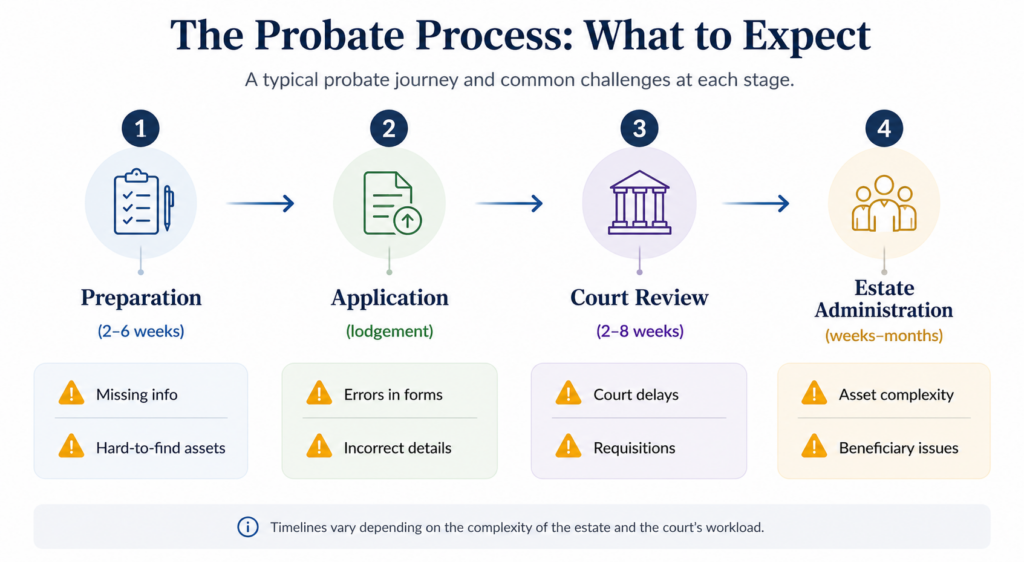
Many avoidable delays happen during preparation and application, especially where documents are missing or incorrect.
Good preparation may help reduce avoidable delays.
Simple vs Complex Timeline Example
Faster (simpler estate)
Example:
- clear will
- one property + bank account
- no disputes
Timeline:
- preparation: 2–3 weeks
- court processing: 2–4 weeks
Total: around 1–3 months
A simple matter may be faster, but timelines vary and this is illustrative only, not legal advice.
Slower (more complex estate)
Example:
- multiple assets
- missing information
- disputes or complications
Timeline:
- preparation: 4–8+ weeks
- court delays: 6–10+ weeks
Total: 4–9 months (or longer)
A more complex estate can take many months or longer; this is illustrative only, not legal advice.
The key difference
Organisation and accuracy are important factors, alongside court workload, estate complexity, and institutional response times.
Mistakes and missing information are common reasons for avoidable delays.
Can Probate Be Faster?
In some cases, yes.
These steps may help reduce avoidable delays:
- gathering documents early
- ensuring forms are accurate
- responding quickly to requests from the court or institutions
Some people choose professional help to reduce the risk of errors and to navigate the process.
Learn more: How to apply for probate
Should You Do It Yourself or Get Help?
In many cases, executors can apply themselves, especially for straightforward estates, but requirements vary.
However, if there are complications, mistakes can slow things down significantly.
Many people find checklists or professional support helpful for staying organised.
What Should You Do Next?
If you’re trying to understand timelines, the next step is usually to confirm whether probate is required.
Start here: Do I need probate in Australia?
You can also explore:
Key Takeaway
- Probate can takes 2–6 months
- Simple estates are often faster, complex ones can take longer
- Mistakes and missing information can be a major cause of delays
If you’re unsure, that’s completely normal, most people are doing this for the first time.
Related Guides
- Do I need probate in Australia
- What is probate?
- How to apply for probate
- What to do when someone dies
- The definitive probate guide – our comprehensive step-by-step checklist
Take things one step at a time, you don’t need to get everything perfect, but being prepared can make a big difference.